


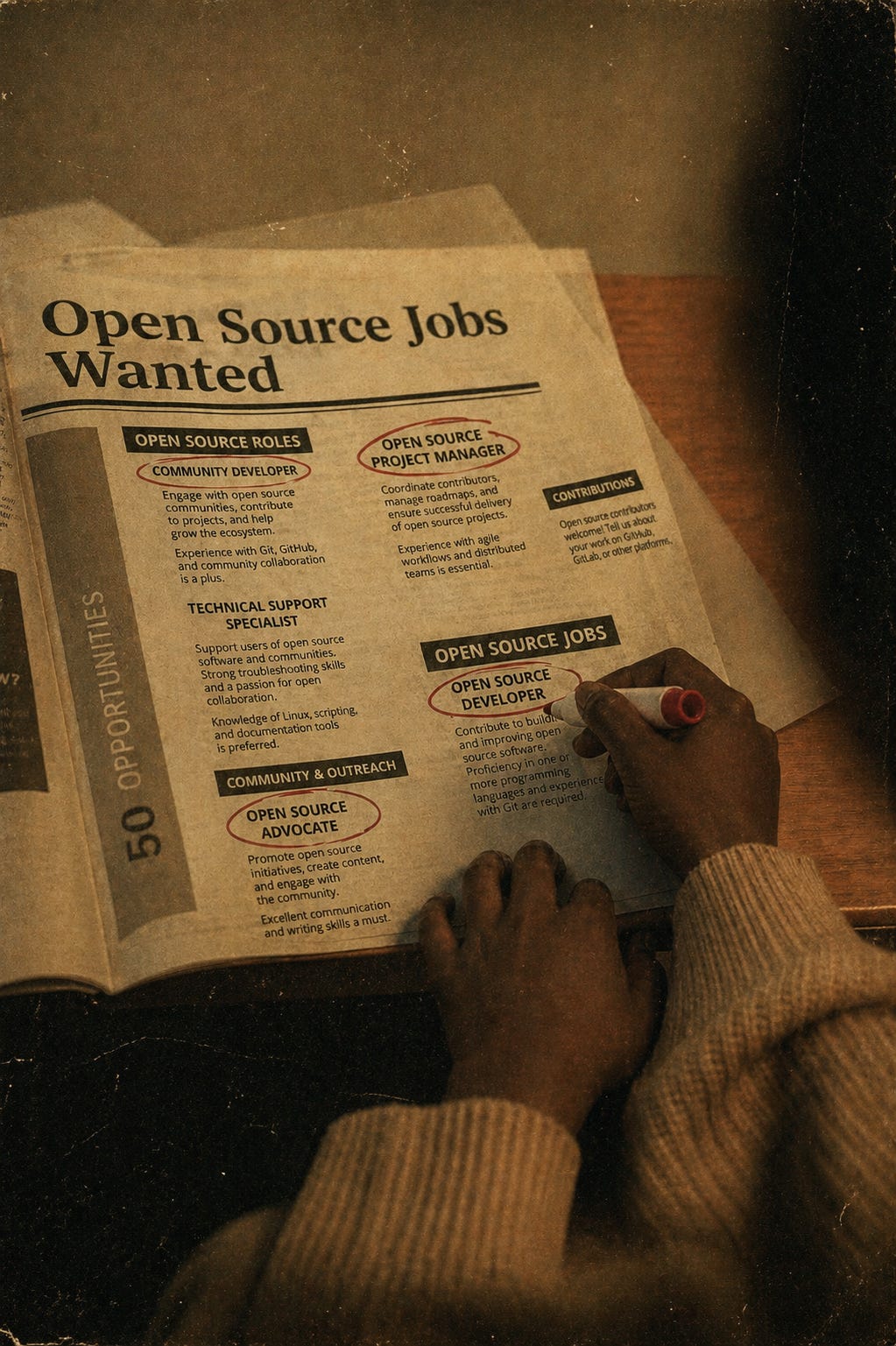
Two weeks ago, I pointed at the gap map and asked you to find a red zone you knew how to fix.
But pointing at the work doesn’t pay for it. Fixing a red cell takes time, and time is what most people capable of the fix are already selling to someone else. So, who actually does the work?
Open source starts everywhere. It scales on payrolls. Linus Torvalds posted Linux to a newsgroup in 1991; it became the kernel that runs the planet after IBM put a billion dollars and 1,500 engineers into it in 2001. Rust was Graydon Hoare’s side project; Mozilla (where I’m CTO) picked it up in 2009 and put engineers on it. PyTorch came out of Meta. Kubernetes came out of Google, carrying forward a decade of lessons from Borg and Omega.
It’s the same script with AI. Look at who’s already paying engineers to close the gap.
The infrastructure layer: Databricks, Hugging Face, Together, Fireworks, Mistral, Anyscale, Modal — one sells something that gets more valuable when open models are enterprise-ready. These are the sponsors of the work. Not in a donations sense. In a payroll sense.
And they’re already hiring. PwC’s 2025 Global AI Jobs Barometer, based on close to a billion job ads, pegged the AI wage premium at 56% — more than double the 25% it found the year before. Motion Recruitment’s 2026 tech salary report saw AI specialization postings up 49%, while senior software developer pay fell 10%.
So the question isn’t whether AI work pays. It’s whose payroll you pick.
Whose payroll already depends on this work?
I’ve been pulling that list as part of my work at Mozilla, posting open roles at the companies actually doing it. You can find an alpha version of it at Weights and Roles. It’s still very rough and very incomplete. (Populating it is the first job. Seventy-eight pages and counting.) I promise, the code goes open source once it’s worth shipping.
If you’re an engineer thinking about your next move, go look. Tell me which companies you’d add.
If you’re hiring at a company building in this stack — open weights, infra, dev tools, governance — email me at raffi@mozilla.org, and I’ll get you on the list. No fee, no tier, nothing to upsell.
The gaps in the above map close when the companies whose business depends on it get to work. Figuring out who those are — and whether you want to work for one — is this year’s biggest question.
That’s not a downgrade from the dream. It is the dream. While getting a salary.
Weekend heroes are great. But let’s get open-source engineers on payrolls.
Chinese labs, benchmaxxing, and the Common Crawl for robot data.
Here’s a snapshot of what I’ve been reading, thinking about, and playing with this week.
This talk has me rethinking reality. (Again.) Carissa Véliz, an associate professor of philosophy at Oxford’s Institute for Ethics in AI, used her TED slot this year to argue that predictions about people don’t describe the future. They bend it. “Social predictions tend to act like magnets,” she says. “They bend reality towards themselves.” Predict a loan applicant is high-risk, deny the loan, and the prediction makes itself true. Her warning: Watch out for anyone who tells you the future they’re describing is inevitable. I made this argument all the time on Technically Optimistic: Technology isn’t inevitable — it isn’t whatever the tech industry hands you — and we have a say in bending where it goes. Véliz takes it further: Inevitability-framing is a command in disguise, designed to get you to skip the architectural review, the eval pipeline, the rent-vs.-own decision. The fraud model you ship next quarter doesn’t describe your customers. It picks which ones get treated like fraudsters and writes the data that proves it was right. Treat every output as a prediction, not a fact. The hedge Véliz proposes on Jeff Wilser’s AI-Curious podcast is hilariously analog: keep retired engineers on speed dial for the day nobody remembers how to run things manually.
Open-source robotics had a remarkable few months…
The simulator: Newton 1.0 shipped in March, codeveloped by NVIDIA, Google DeepMind, and Disney Research, and powering Disney’s Star Wars-inspired BDX droids. It’s hundreds of times faster than the previous open standard on manipulation tasks;
The body: Asimov Inc. open-sourced its full bipedal humanoid on April 27, with a $15,000 DIY kit on pre-order. If $15K is today’s cost, imagine 18 months from now; and
The full stack: RoboParty’s roboto_origin, out of China, went from blank sheet to running, jumping prototype in 120 days, with a BOM you can fill from Taobao. Earlier this year, K-Scale Labs collapsed while trying to raise $20M for industrial tooling. RoboParty bypassed the problem with off-the-shelf parts and a 3D printer. The pieces are now sitting in public repos. It’s the same rent-vs.-own choice tipping point for LLMs is landing on the embodied side.
TRELLIS.2 has been sitting in my tabs since December. Microsoft Research, with Tsinghua and USTC, shipped a 4B-parameter image-to-3D model: single picture in; fully textured GLB out. MIT license, weights on Hugging Face, full PBR materials — base color, roughness, metallic, opacity. Not a placeholder mesh. I wanted to tinker. Local install needs 24GB+ of VRAM, verified on A100 and H100, neither of which I have lying around. So I almost dropped it. Then I noticed Microsoft hosts it on Hugging Face Spaces. I tried two images: a render of a podcast player I’d been imagining (designed object, controlled lighting, the kind of thing it should handle), and then, to push the model, the Space Garden, my friends Ariel Ekblaw and Thomas Heatherwick’s orbiting greenhouse, featuring 30 pods around a luminous pomegranate tree — the kind of organic-meets-engineered weirdness I was sure TRELLIS.2 had never seen in training. It worked. The Common Crawl for robot data nobody’s been able to scrape may just end up getting generated instead.
Meta confirmed the model side is moving the other way. The first thing out of its nine-month-old Superintelligence Labs is Muse Spark: closed weights, no parameter count, no architecture details. Meta’s been one of the most prominent US advocates of open weights for two years, and that ladder just lost a rung. Their attempt to buy capability from China got cut off, too: Beijing blocked the $2B Manus acquisition — the Chinese-founded agent startup whose product runs on Anthropic models — ordering the deal unwound and blocking both founders from leaving the country during the probe. As I argued earlier this month, the open-source capability gap is closing fast, and Chinese labs are doing most of the closing. The center of gravity in open weights now sits with Qwen 3, DeepSeek, and Kimi, with Mistral and Gemma being the strongest non-Chinese alternatives. Llama isn’t dead. It’s also no longer in the top tier.
The view from inside one of those Chinese labs is more complicated. Zhang Chi spent 2025–26 inside ByteDance Seed, the team behind Doubao, China’s most-used chatbot. The released-weights gap may be closing, but Zhang says the frontier-research gap is widening. He claims Google can iterate a full pre- and post-train cycle in three months, while ByteDance takes six: Every US cycle, the Chinese labs fall another generation behind. He says they’re benchmaxxing on paper, leaning on distillation from Claude, Gemini, and ChatGPT instead of building real data pipelines. The most entertaining detail, though, is what Zhang and his colleagues use for their own work — Claude Code, Codex, Cursor — meaning the next ByteDance model is partly being built by Claude Code. Even so, Zhang says the harness wasn’t the prize. What matters, he tells Into Asia, is still “the model in the backbone, the foundation model that it calls.” The leak gave you the harness. The capability still lives behind the API.
Go one rung deeper and it gets stranger. This week, the Office of Science and Technology Policy director Michael Kratsios issued the executive memo NSTM-4: Adversarial Distillation of American AI Models, framing foreign labs querying frontier models to train cheaper students as IP theft. (Nathan Lambert is worth reading alongside: distillation gets Chinese labs to benchmark parity, not to capability parity, and regulating it won’t change the underlying race.) Days earlier, Nature published a paper on subliminal learning: distilled students inherit behavioral traits — misalignment included — through hidden statistical signals that survive aggressive filtering. The under-discussed finding: transmission only works when teacher and student share a base model. The paper doesn’t tell us what cross-base distillation cleanly preserves or filters out, but it does suggest Kratsios is at minimum solving an incomplete problem. The chains most exposed to this kind of inheritance live inside the frontier labs themselves, where teacher and student lineage match by design. (And if you’re fine-tuning a smaller model on outputs from one of its larger siblings, that’s you, too.) Weights won’t tell you what your teacher passed down. Neither will the data. Only behavior will.
The data you don’t want in the cloud doesn’t have to leave your machine. OpenAI just shipped Privacy Filter, a 1.5B-parameter MoE model for detecting PII in text. Apache 2.0, runs locally, 96% F1 on the standard benchmark (97% on a corrected version). Within 24 hours, Alvaro Videla reported porting it to Apple Neural Engine using GitHub Copilot — claiming 15× faster than CPU, 19× less energy per sentence, 0.22 watts of draw. If you’ve already got your Mac running as a model server, this is another floor in the same building.
US policymakers are openly discussing stronger state control over frontier AI. The Atlantic this week reports that Hegseth threatened Anthropic with the Defense Production Act, while senators have proposed legislation to “explore” nationalization. As I argued in the Times last week, even programs designed to broaden access — Anthropic’s Project Glasswing extends Mythos defense capabilities to dozens of organizations and funds open-source security groups — still concentrate decision-making in a handful of frontier labs deciding who gets early defensive tooling. None of this changes what you ship Monday. It does change whether your API access is still a market relationship — or already a national security one.